Claudio Musso & La Société Spectrale
Conversation#2
NEXT LEVEL
Interview with the founders of the DebatikCenter of Contemporary Art on the occasion of the exhibition PUSHING THE LIMITS, curated by Fabiola Naldi at Galleria de'Foscherari (Bologna: 17 October 2025–18 January 2026).
by Claudio Musso
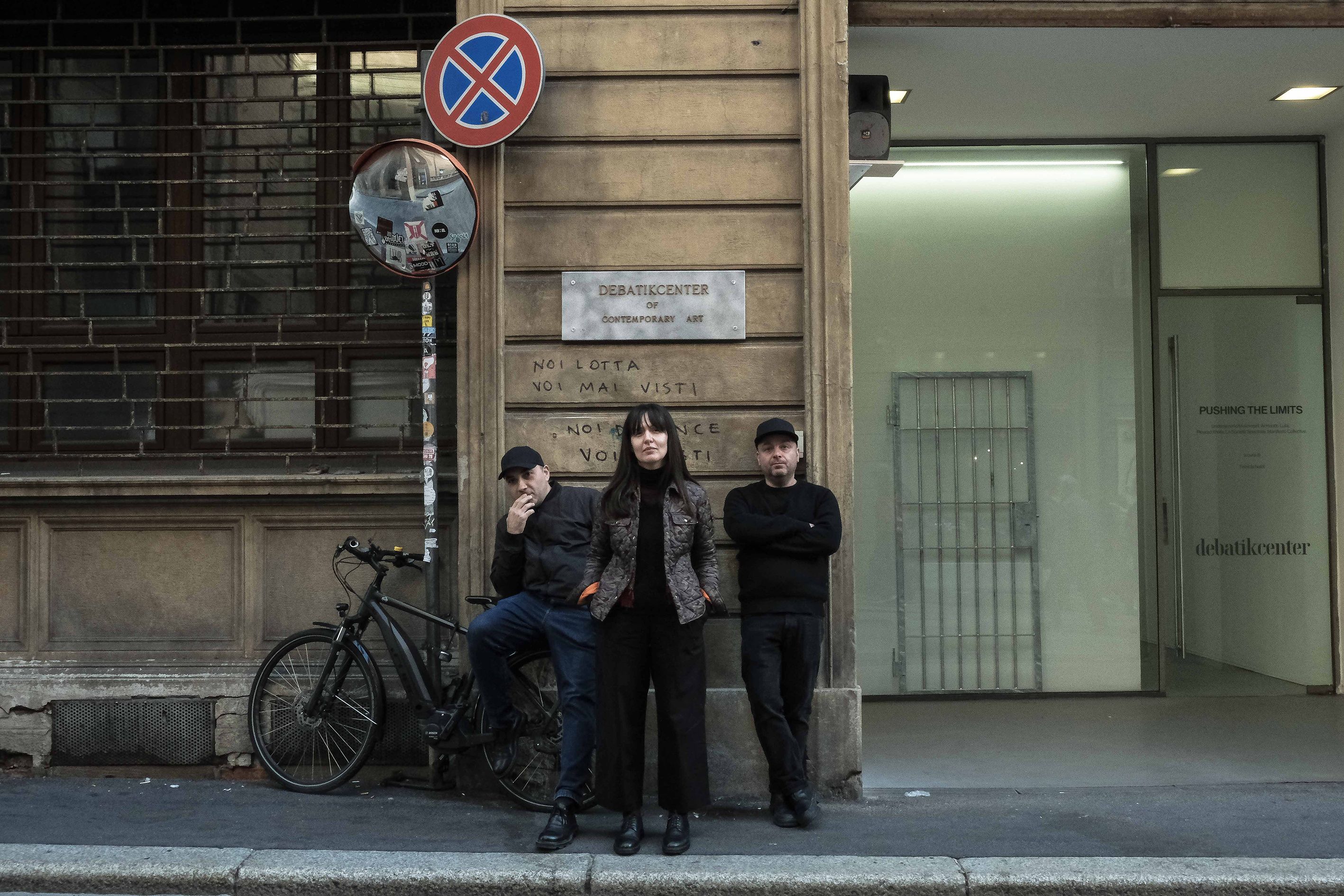
From left: Armando Lulaj, Jonida Gashi, and Pleurad Xhafa, co-founders of the DebatikCenter of Contemporary Art and members of the collective La Société Spectrale. Galleria de'Foscherari, Bologna, October 2025. © D.C.C.A. Archives.
Claudio Musso: Your story begins more than twenty years ago, at a time when Albania was experiencing an unprecedented political and economic transformation. A recurring theme in your journey is the idea of "mapping what escapes", of intervening in the territories where the official narrative breaks down. What are the conditions -- cultural, urban, political -- that made it necessary to found the DebatikCenter of Contemporary Art (D.C.C.A.), and how has this original need transformed over the years?
Armando Lulaj: The founding of the D.C.C.A. was prompted by several political developments that occurred in Albania between the late 20th and early 21st centuries. In 1998, when the country was trying to lick the wounds opened up by shock therapy, festering wounds that have still not healed today, two of my colleagues and I left to study at the Academy of Fine Arts in Florence. The Academy was not the best, between 1999 and 2000 I wrote a manifesto entitled Underground Movement that determined many of our future projects: from the opening of an art center to specific actions such as Walking Free in Harmony (2001). These future projections ended -- or rather, began -- with my expulsion from the Florence Academy in 2001, precisely because of the Walking Free in Harmony action, and with administrative measures against my two colleagues: Ergin Zaloshnja and Salvator Qitaj.
.jpg)
Armando Lulaj, Walking Free in Harmony, January 23, 2001. Performance on the roof of the Galleria dell'Accademia. Florence. © D.C.C.A. Archives.
I was forced to move to Bologna, which in those years was a city where political action and art were constantly being questioned, so it was the right place. In the spring of 2003, the three of us gathered in Bologna in an apartment located in the Murri area and founded the D.C.C.A.
From its inception, the D.C.C.A. was conceived as an independent art center with a sort of forked mechanism, that is, two paths within it: art and politics, to analyze and question them. Two distinct and parallel paths, which would undoubtedly have culminated in a future disaster...
Today, thinking about it and analyzing the center's twenty-year journey, I firmly believe that our goal, perhaps unconscious, was to correct as much as possible the violent and dizzying convergence of art and politics, which has manifested itself better in Albania than anywhere else in the world, and which has shaped the narrative of the local scene.
After founding the center in Bologna, our goal was to return to Albania and move to a new apartment in Tirana, which, unlike the one in Bologna, we transformed into an exhibition space. I've always been fascinated by houses becoming exhibition spaces.
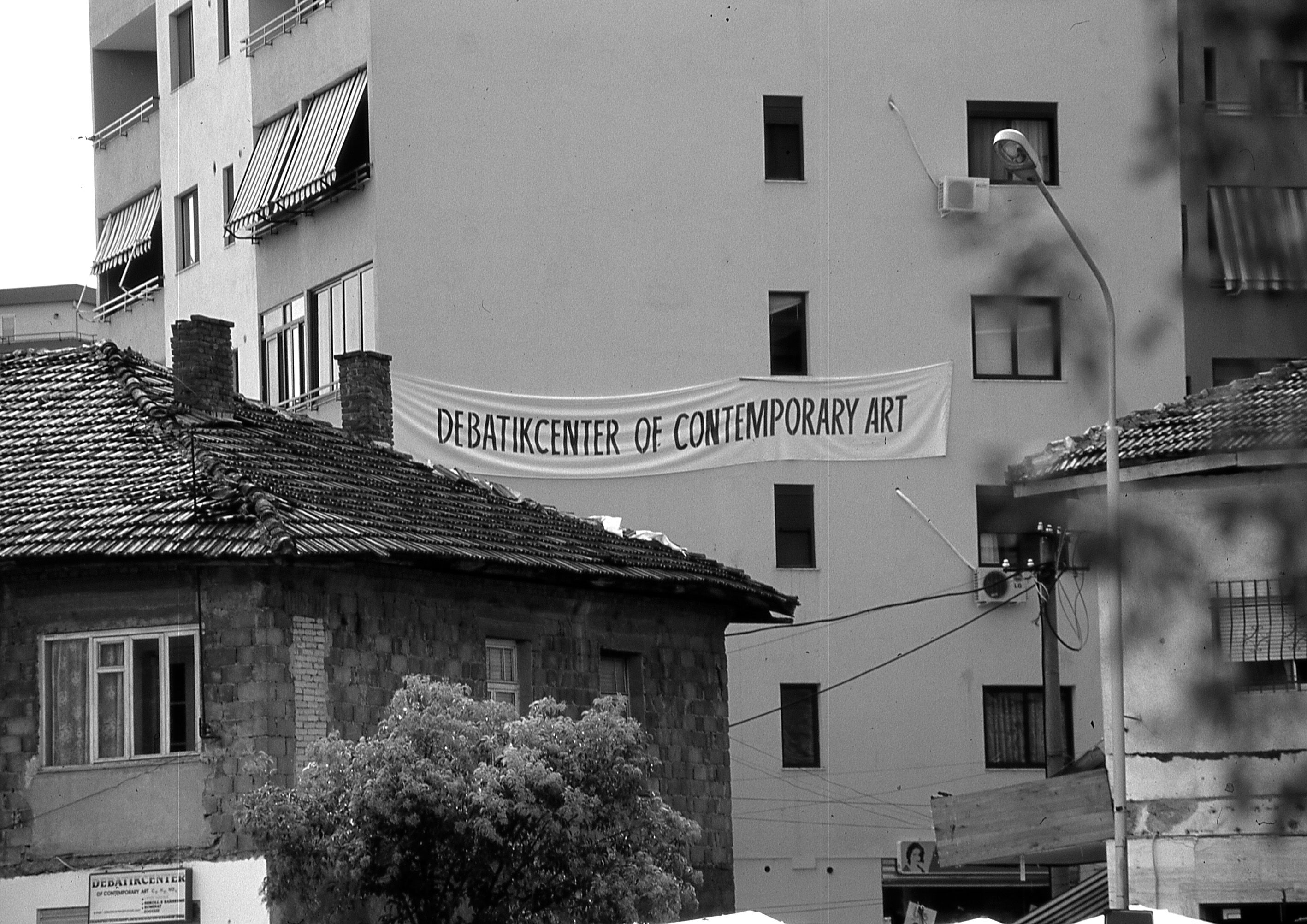
Documentation of the inauguration of the DebatikCenter of Contemporary Art. September 11, 2003. Tirana, Albania. © D.C.C.A. Archives.
The inauguration took place in September 2003, during the second edition of the Tirana Biennale, followed by a series of performance actions, such as Brotherhood Phobia (2003), intended to criticize the very model of biennials, so widespread at the time. Our intention was to challenge the neoliberal paradigm, the models imported from abroad that were invading the country, spreading a catastrophic allure everywhere. This was the main reason why the D.C.C.A., which came from abroad like all the above-mentioned enterprises, decided to act in the same way, to use the same tools, but instead of spreading neoliberal culture, to spread a critique of neoliberalism.
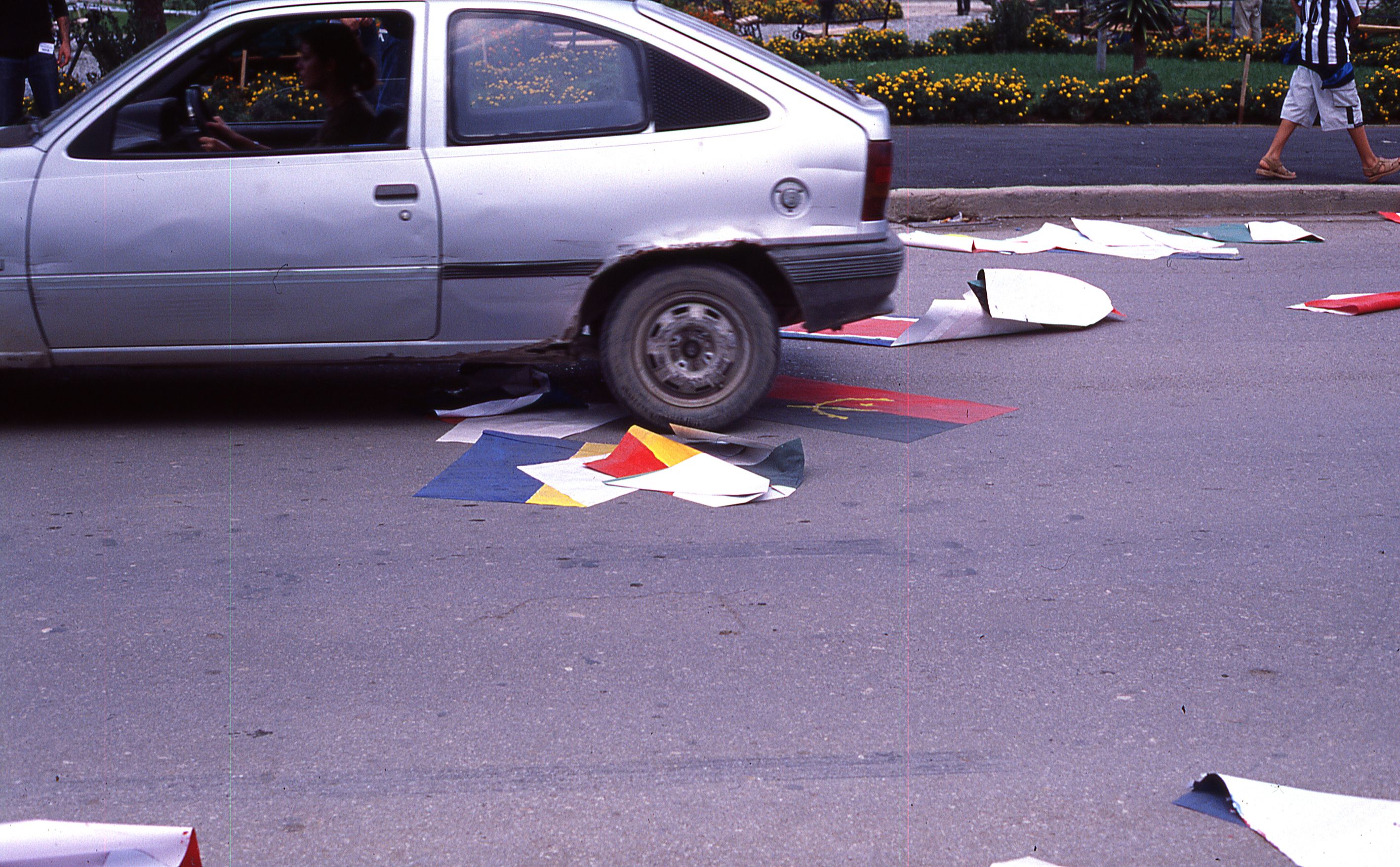
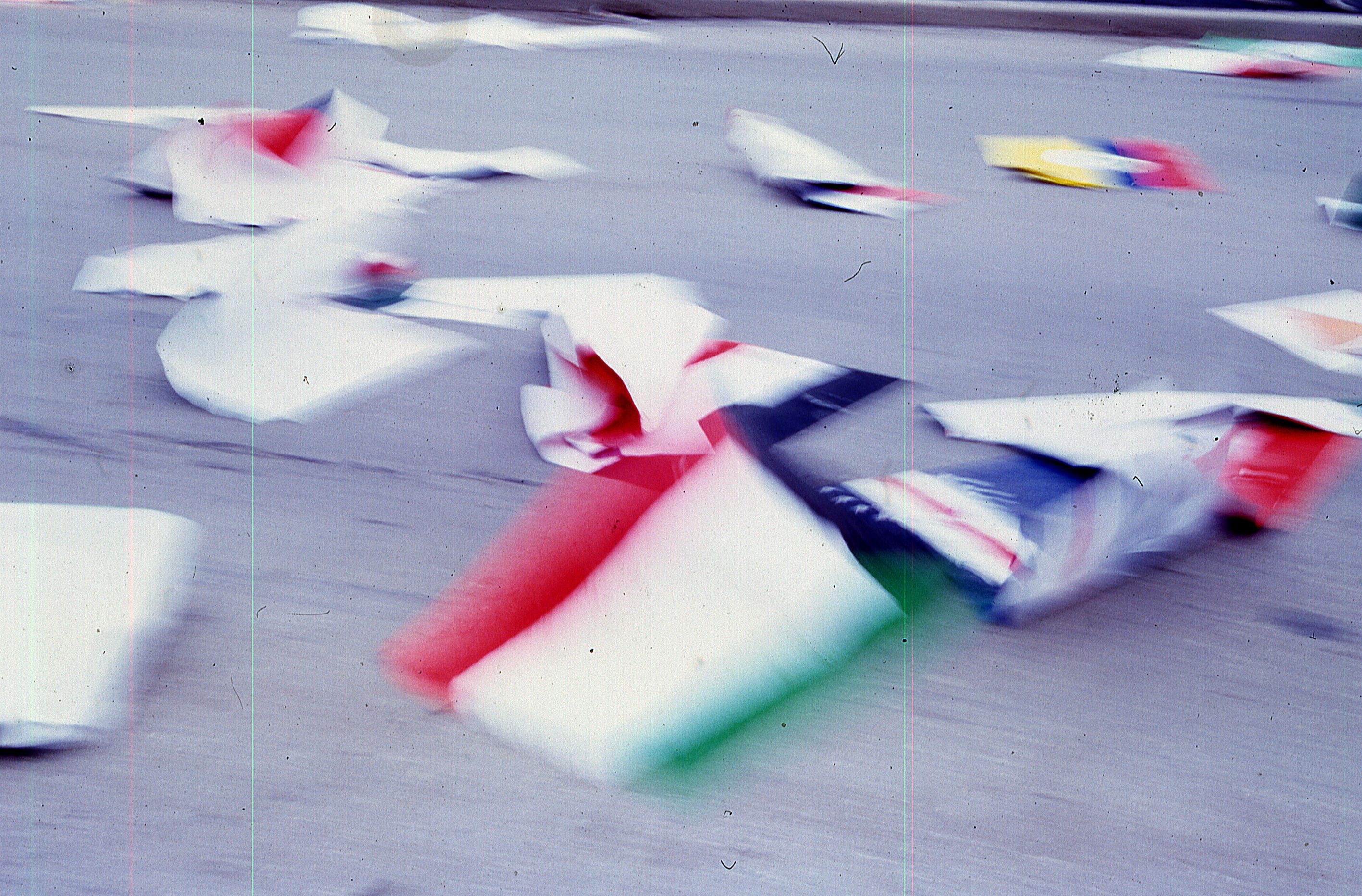
Armando Lulaj, Brotherhood Phobia, 2003. Action during the inauguration of the DebatikCenter of Contemporary Art. Tirana, Albania. © D.C.C.A. Archives.
Jonida Gashi: It is important to keep in mind here that the Albanian contemporary art paradigm as we know it today has its roots in the disastrous events of 1997 and the (neoliberal) management of its aftermath. In the course of that fateful year, what started out as a crisis in the (private) financial sector triggered by the collapse of the so-called 'pyramid firms', quickly engulfed the entire state apparatus and all aspects of the life of the society. This was hardly surprising, given that the collapse of the Ponzi schemes wiped out the savings of approximately two thirds of the Albanian population at the time -- a loss estimated to exceed one billion US dollars. Furthermore, the emergence of these questionable financial institutions in Albania, which functioned like an informal or unofficial banking system in the early 1990s, can be tied to the adoption of shock therapy reforms intended to transform Albania's beleaguered planned economy into a thriving market economy, in accordance with the neoliberal developmental model being peddled by the likes of the IMF and the World Bank in the countries of the former Eastern Bloc. Nevertheless, the crisis was swiftly blamed on Albanian institutions and on the Albanian people -- who had failed to properly grasp the workings of capitalism -- and ultimately served as a pretext to usher in even more neoliberal reforms. As a result, the neoliberal modelling of Albania's economic-financial sector (and not only) continued unfettered in the post-97 era, an ongoing process that shows no signs of abating even in the present day.
Albanian contemporary art played a key role in this process of neoliberal consolidation. Beginning in the second half of 1997, key members of the Albanian postsocialist art scene started to adopt a discourse whereby crisis could and indeed should be transformed into opportunity. A striking display of the neoliberal ethos characterizing Albania's art discourse around this time can be found in curator Edi Muka's short text "Free Fall in the Albanian Trance", published in August 1997. Comparing the events of the previous seven months to a rollercoaster ride that starts out as frightening but ends up as pleasurable, Muka concludes by proclaiming that "the disappearance and the reconstruction of the relations between individual and society, body and surroundings, sex and society, and many others" has produced "one of the most fertile territories for art production". A series of international shows followed soon after, all of them organized under the patronage of Albania's new Minister of Culture, Edi Rama. (The latter quickly affirmed himself as an aggressive champion of neoliberal reform in the cultural sector, most famously -- or, rather, infamously -- in the Albanian National Theatre.) These exhibitions, culminating with the second edition of the Tirana Biennale in 2003, launched Albanian postsocialist art onto the global art scene. They also cemented the perception that Albanian contemporary art was born at the turn of the twenty-first century, effectively transforming the 1990s decade into a gaping void. The ideological function of this erasure was obfuscation: of the historical connection between capitalism and crisis as embedded in the upheaval of 1997; of the multitudinous continuities between the events of 1997 and contemporary Albanian society; of the sensation that, at some point back in the 1990s -- perhaps at the height of the crisis -- there might have been opportunities for formulating alternatives to the status quo.
Pleurad Xhafa: Jonida, Armando, and I returned to Albania around the same period, between 2012 and 2013, with the idea of settling here permanently.
Edi Rama's government had just come to power, and one of its most incisive slogans was that it would transform Tirana into a kind of new Berlin for contemporary art. I remember very well the enthusiasm of many cultural workers when Rama spoke of unprecedented cultural changes. The vast majority of artists voted for him and his government, convinced that a real space for art and culture was finally opening up.
From the beginning, it was clear that art had been integrated into the political project, used to soften brutal policies, mask social violence, and make openly neoliberal change digestible. A defining moment in 2015 was the opening of the Center for Openness and Dialogue (C.O.D.), located on the ground floor of the Prime Minister's office, in a fascist-era building. Presented as a space for openness and dialogue, it actually marked a clear transition: art entered the heart of power physically, not just symbolically. Most of the artists who had supported Rama never questioned this relationship: they preferred to stay in it, waiting for something to come from above for them, too.
I remember that during that period, meetings and discussions between us became increasingly frequent. The relationship between art and power was taking an increasingly problematic form. In this context, Jonida's article, These Are (Not) the Things We Are Fighting For, written in 2015, precisely in relation to the C.O.D., was fundamental. It was not just a critique of a specific space, but an attempt to focus on an entire dominant narrative. Soon after the C.O.D. opened, it became clear that independent spaces for art and cultural work would progressively shrink. At that point, we began to seriously think about a reorganization of the D.C.C.A., not as an institution in the classical sense, but as a workspace: a laboratory, an active archive that could compensate for the disappearance of autonomous places. We had no support or funding whatsoever. Everything was self-produced. This forced us to completely rethink the way we operate: how to produce meaningful interventions, with real impact, but without funding.
Working in public spaces was nothing new to us, but this practice took on a new urgency within a specific political context. We started from symbolic places like Skanderbeg Square, redesigned by the Rama government through a corrupt tender process and transformed into a pyramid, which exalts the individual and empties the space of its political function. The works we produced were direct and related to very specific situations. We called these actions Strikes: rapid, site-specific interventions designed to respond immediately to a specific event, without going through lengthy mediation processes. At that moment, it became clear that the D.C.C.A. was not returning but was re-emerging as a mobile, intermittent presence that was difficult to pin down. It is in this spirit that, in 2017, we decided to reactivate the DebatikCenter of Contemporary Art as an instrument of countercurrent intervention, opening it to a plurality of people, emergencies, and conflicts.
CM: The exhibition PUSHING THE LIMITS at the Galleria de'Foscherari is clearly presented as "a non-exhibition", a device in which heterogeneous materials -- geopolitical analyses, video recordings, traces of public interventions -- are linked to generate friction and not to be ordered. What is the principle that guided the selection and arrangement of these materials? And what are you trying to undermine in the very idea of an exhibition as an institutional format?
AL: PUSHING THE LIMITS is like a milestone in our history, a return to Bologna, the place where it all began, made possible thanks to the vision of curator Fabiola Naldi and gallery owner Francesco Ribuffo. Along the way, many of our collaborators have tried to discredit art along with the political system, using every possible means, also trying to engage and activate different audiences, even performing for a wider audience or, as Jonida says, for an audience that doesn't exist yet. This non-exhibition underlines this position once again and openly opposes the impotence of the spectator. We are against the impotence of the spectator. We want to reactivate the spectator!
The exhibition space displays artifacts and works of art that have survived from the founding of the D.C.C.A. to the present day. However, they are all objects and archival elements capable of shedding light on our terrifying present, which are reactivated, made to rise in space, to create friction, conflict, spatial and conceptual violence, stimulating the gallery's status as the representative space of the art system.
All of us -- Jonida, Pleurad and I -- have a soft spot for cinema. Jonida's research is theoretical and focuses on moving images, Pleurad and I are video artists and film directors. There is a certain narrative drive that leads us to edit the present (which derives from cinema), and this is also reflected in the exhibitions we organize. A condition that is very well reflected in the space of the Galleria de'Foscherari, a space hijacked by the D.C.C.A. precisely to further accentuate the crisis of our present, the imminent collapse of the art system and the political class today.
Undermining, sabotaging, and questioning the very idea of an exhibition is the first step; trying to rethink it is the next. We need to start with the little things, like rethinking the vernissage, for example. I have done many such experiments with the MANIFESTO project, whose exhibition section I curated. It takes time to activate the spectator of the future and find ways to engage him. With the three exhibitions of the MANIFESTO project, entitled Hijacking, Desertion and Great Wave, we have performed (also) for the spectator of the future.
They are indigestible proposals within institutional formats. To put it bluntly: I've always loved James Lee Byars's idea of painting the interior and exterior of the Guggenheim Museum in New York in matte black. It's an idea I'd like to repropose, and now is the perfect time to do so, but institutionally speaking, this project still seems unfeasible.
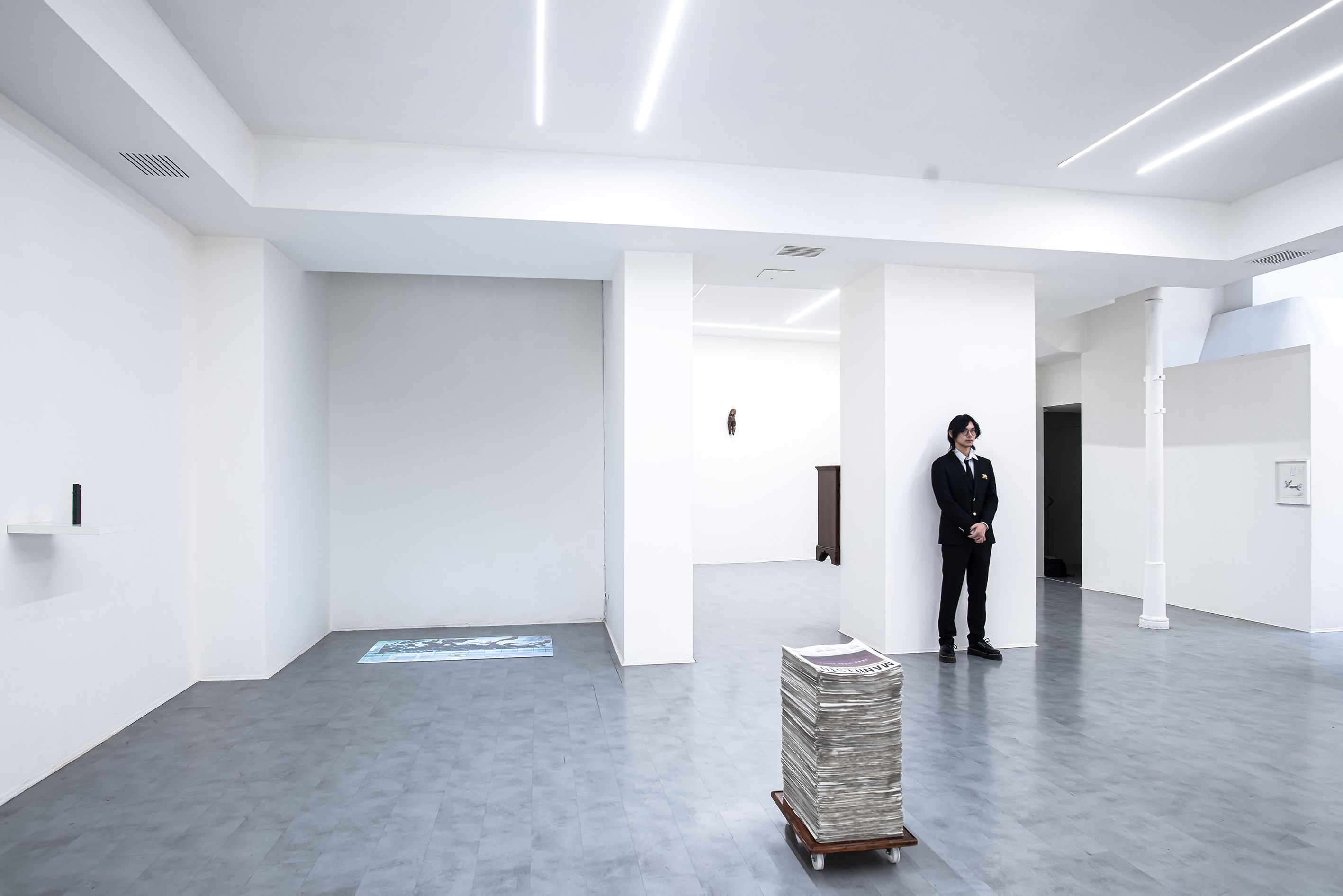
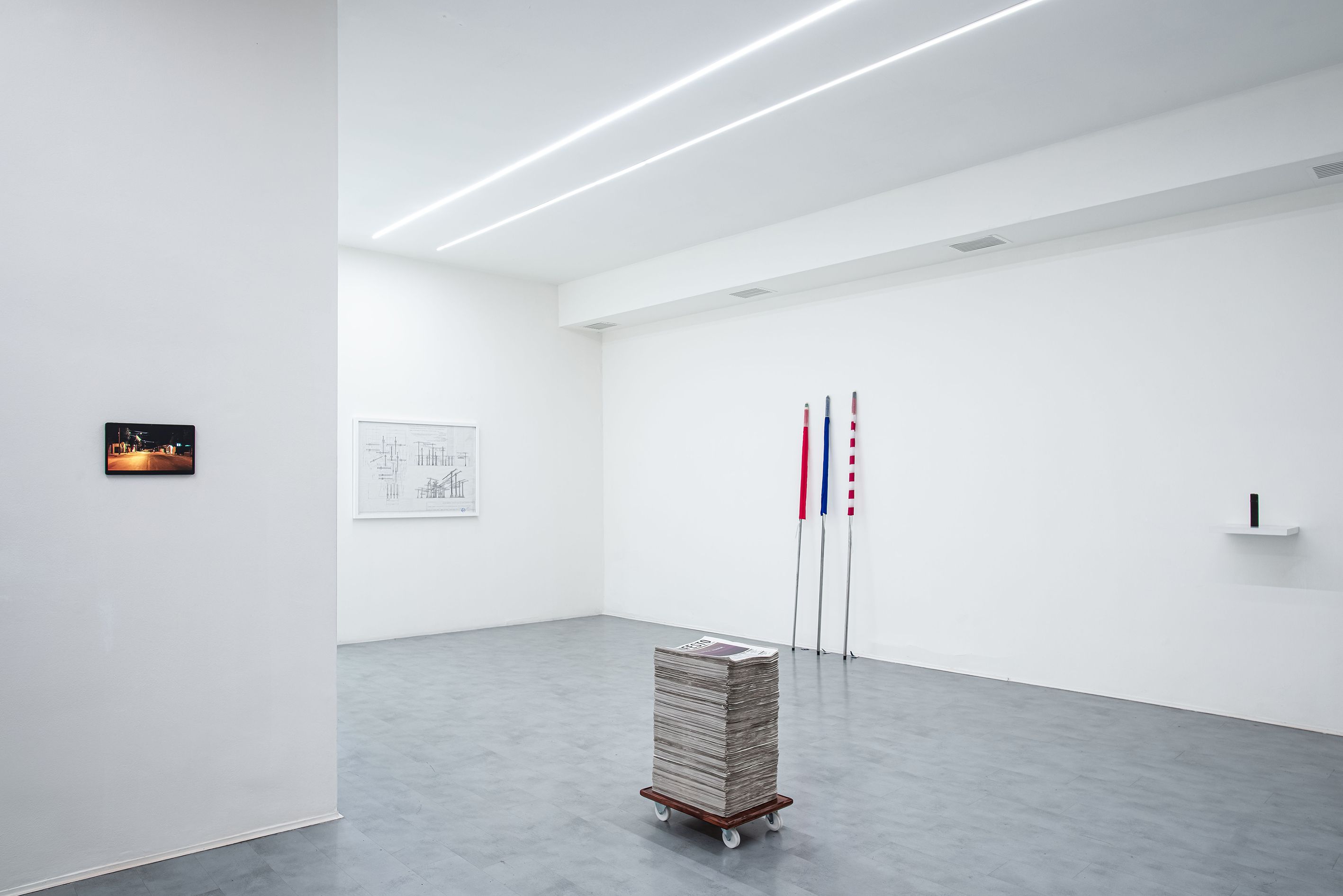
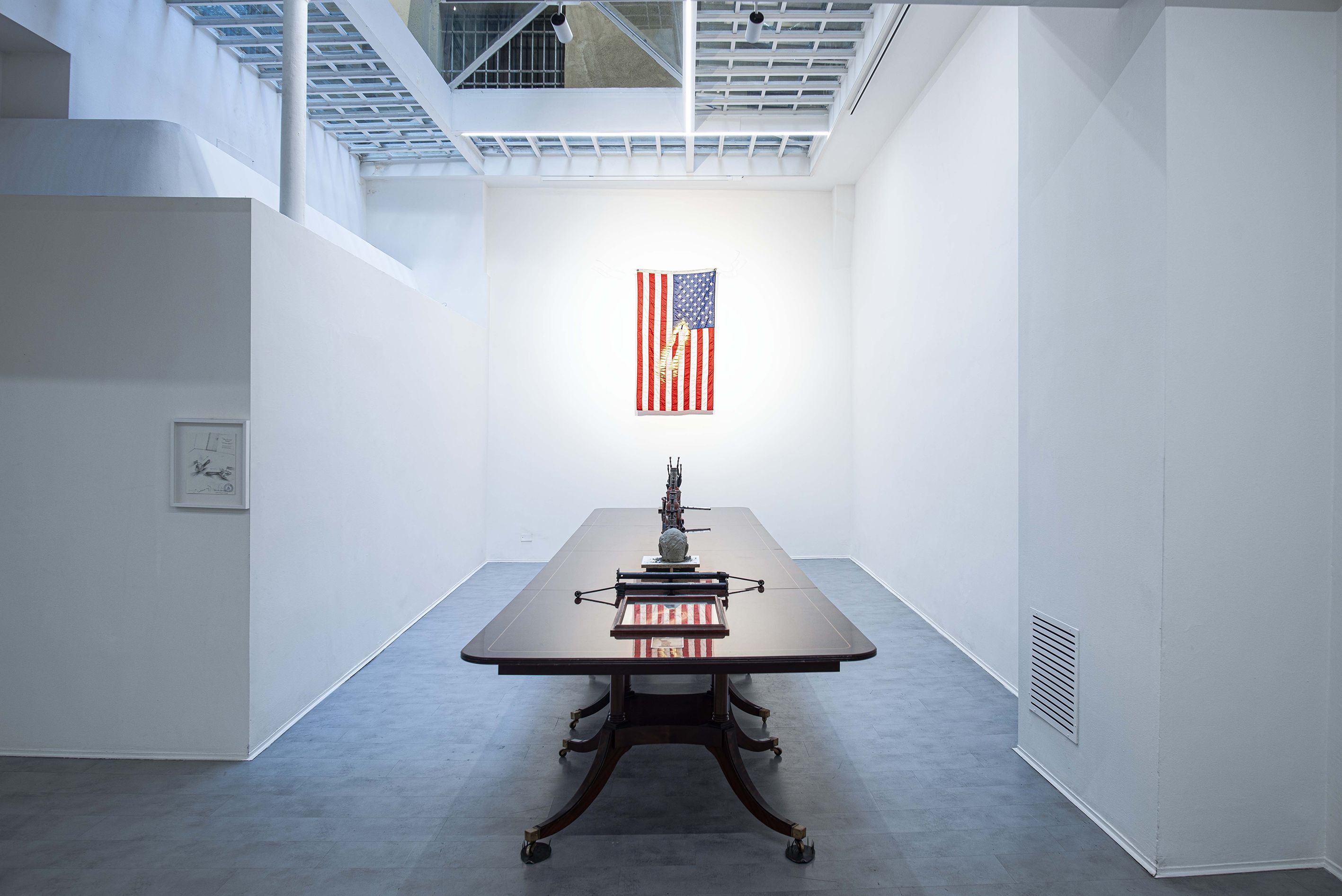
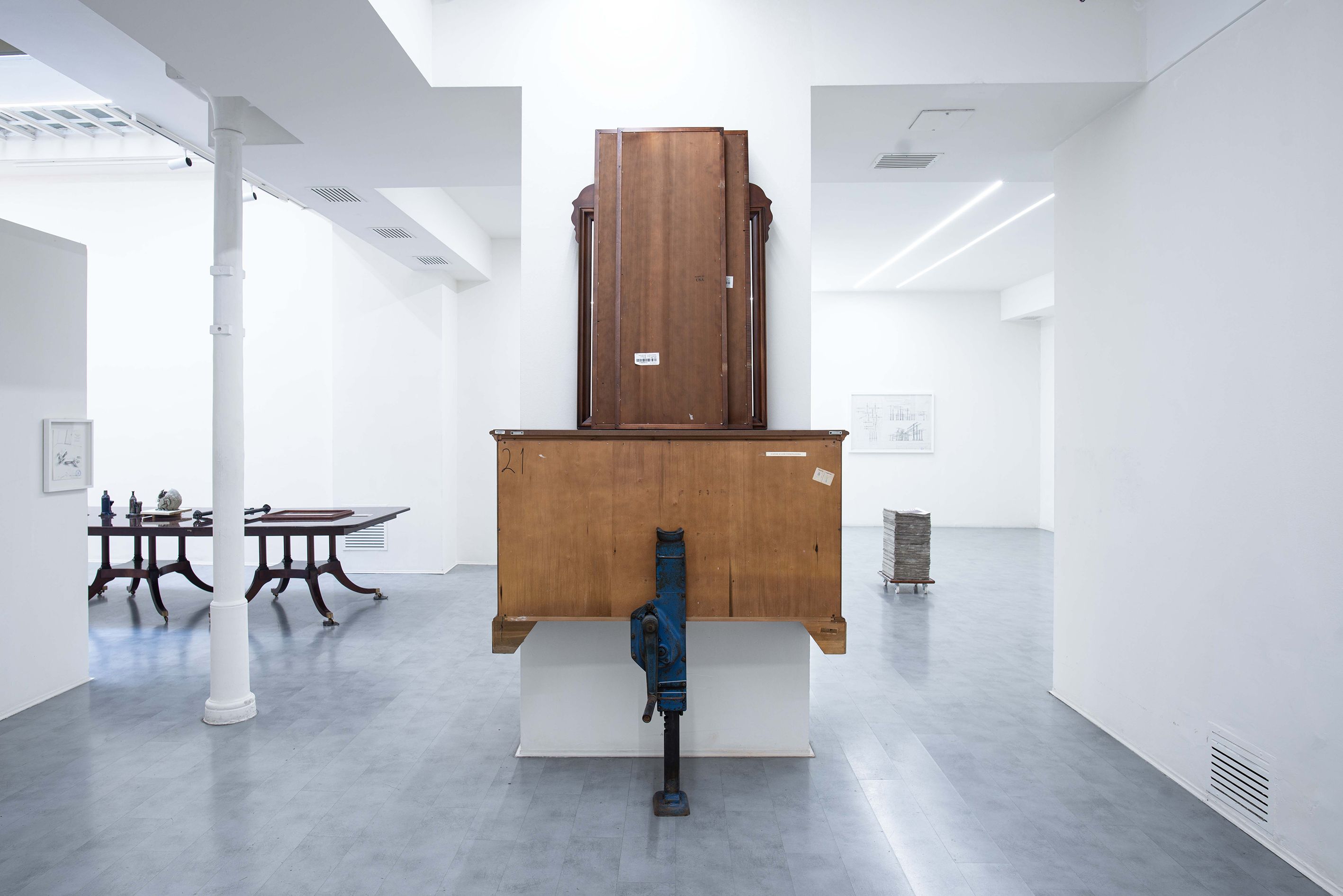
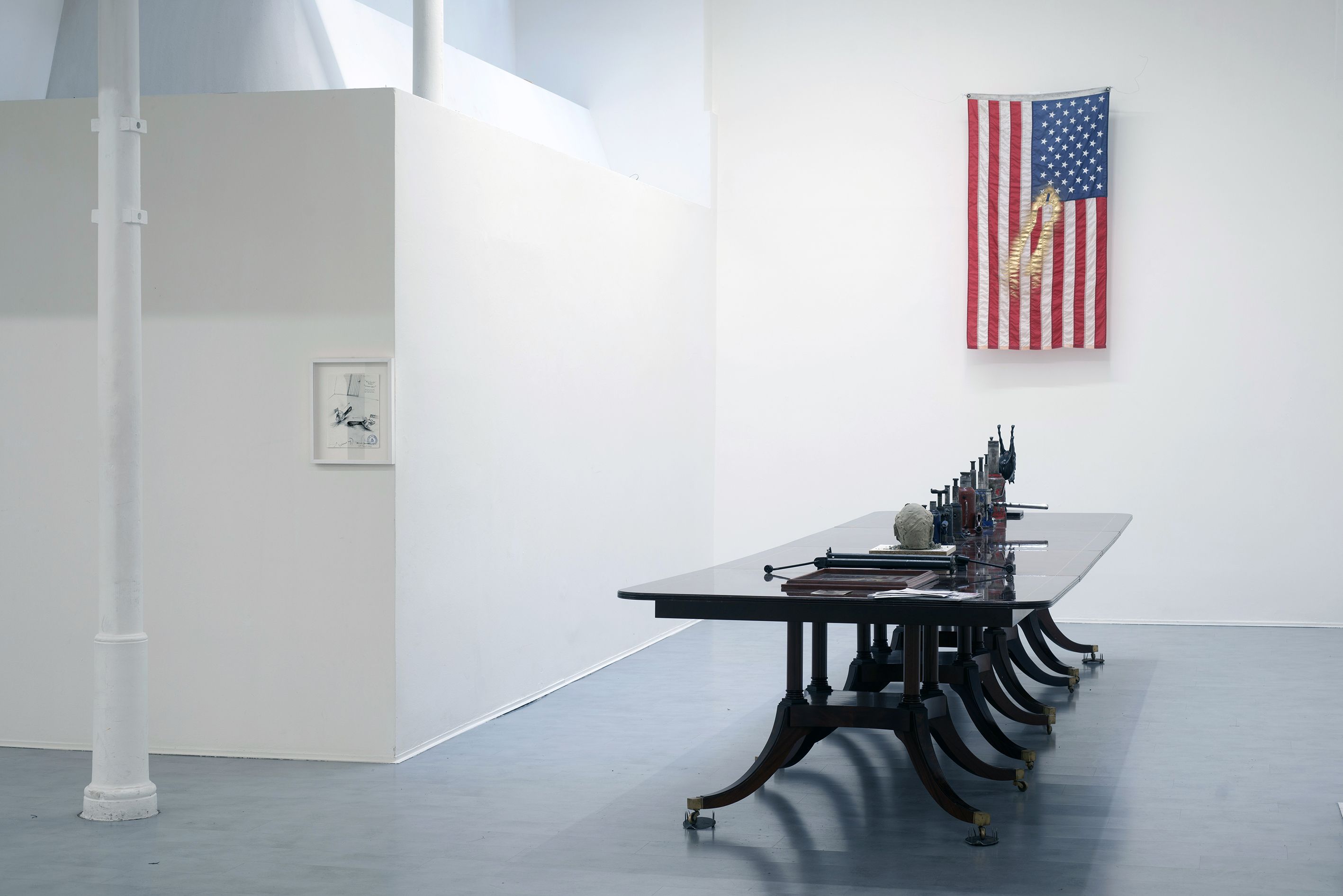
Partial view of the exhibition PUSHING THE LIMITS. Galleria de'Foscherari. Bologna, 2025. Photo © Galleria de'Foscherari. Courtesy of Galleria de'Foscherari and DebatikCenter of Contemporary Art. © D.C.C.A. Archives
CM: A significant part of the project concerns the construction and manipulation of images of power: from the USA to the Middle East to Italy, your investigation traverses political geographies that are rarely juxtaposed in a single narrative. How do you carry out this "reconfiguration", and what role does the artist have for you in remedying -- or sabotaging -- the cultural maps imposed by international politics?
PXH: We are in the second year since the extralegal agreement between the Rama and Meloni governments, and the Gjadër camp, located on the outskirts of the city of Shkodër, continues to operate as a place for the detention and deportation of migrants from Italy. Over the past two years, international human rights organizations have organized protests on the ground, as well as public complaints and forums, clearly demonstrating the illegality and violence of this device.
What strikes me most, however, is the silence and almost total absence of Albanian artists, especially those who have worked on the topic of migration for years. A theme that has been central to an entire generation of transition-era artists now becomes marginal, just as it ceases to be a metaphor and becomes a concrete political reality.
The Gjadër camp is a very clear model: a space where power decides who can be free, who is locked up, and who must be moved or expelled. It's not just about managing migration flows, but about directly controlling people's lives, establishing conditions, decreeing destinies, and doing it as if it were normal. This is where the reconfiguration of images of power becomes central. This logic is neither isolated nor local; it is a colonial logic that returns whenever a system of government arrogates to itself the right to decide who must live and who must die, who can be fed and who can be left to starve, who can stay and who must be driven from their land. The locations and levels of violence change, but the mechanism remains the same.
Our work starts from here, not to describe these situations, but to influence and disturb the functioning of the images that make these situations acceptable. To relate the Gjadër camp to Italy, to the United States, or the Middle East is to show how the same dynamics of oppression are repeated through different languages and contexts. In this sense, for me, the artist must work precisely at the point where images cease to be neutral and begin to reveal what is excluded.
AL: "Albania is neither a destination nor a transit station, but a space in perpetual reconfiguration to adapt to changing geopolitical interests: an open-air processing zone where isolation and oblivion are reframed as hospitality." Territorial analysis has always been a focal point throughout our research. The country has become a buffer zone where geopolitical, economic, mafia and cultural power interests converge.
We are a country controlled by US policy and its interests, where EU interests are at stake and where the recent government of Israel is a major interlocutor. We are a country where Israeli Cultural Week is celebrated and not contested by the art scene, despite the ongoing Palestinian genocide. It is devastating to work as an artist, director, or theorist in this territory, where one has left oneself without the support and solidarity of one's peers.
If there is one thing that needs to be sabotaged, destroyed, it is precisely this mentality that is structural: we tried to dismantle it with the force of argument, I believe, we dissected this structure into parts as if it were a carcass inside an autopsy room, but that is not enough.
I remember when I exhibited my work POWERSHIFT CIA on the facade of the National Gallery in Tirana in 2002: Neoliberalism arrives like a rabid dog, a pitbull entering the scene violently. At the time, there was confusion about what I was trying to say and how the United States of America was represented in my work. It was one of the first critical works on the new neoliberal path taken by the country. Cultural workers, curators, and "phenomenal" artists (as they were referred to by others and as they referred to themselves) were accustomed to criticizing communism, certainly not the neoliberalism they had recently embraced. Even though I was very young, it was a great surprise for me to find myself faced with these contradictory attitudes at that moment.
Albania today is a laboratory for capitalist experiments, a country that is perpetually in a state of emergency, a wasteland of the empire ruled by corrupt politicians who have adorned politics with contemporary art. The majority of cultural workers dance to the rhythm of this imperial symphony. The most striking recent case sealing this state of exception is precisely the covert agreement of the Gjadër camp, which will be followed by similar agreements between Rama and other European leaders. This perspective of contemporary Albania is closer to reality than that of Albania as a land of tourism that is being propagated with such fanfare.
Albania's established art scene is not interested in the above and is guiding the new generation to believe that art should not analyze political issues. I think I understand how the new generation of artists thinks. They are now afraid to react to corruption because they know that in the past the careers of some promising artists in Albania were erased, destroyed by these very artists close to the government. That is why the critical gaze of the Albanian artist has collapsed, and the art that is being produced is weak. This is why politics, economics, power, violence, organized crime, and social rape are not interesting subjects for Albanian artists.
Today there is no "individual life that is not defined, shaped or controlled by some apparatus", says Agamben. I decided long ago that I would never be a broom in the hands of power. The worst thing for me is to see artists as court composers, ambassadors of art, or government bridesmaids.
On the other hand, Europe has precise and very simple rules on how a democracy should work. One of the most important rules is knowing how to pretend, collaborate with the government and not criticize, not raise opposition. It is precisely this normalization of the rules, the ease with which things are accepted without questioning anything, that worries me. It is in this spirit that the country's new art institutions are being established. New institutional agreements on how to distribute taxpayers' money to artists are signed in a total conflict of interest, while parties are held every day, always with taxpayers' money. None of them sleep: like circus animals, cultural workers can dance and sing in government villas for three days straight. They remain wide-eyed for three days straight. "The sleepless soldier is the sleepless worker or consumer", says Jonathan Crary. These are some of the crazy, cheerful, worldly, socially elected normalizations -- as Pasolini defines them -- where no discourse is produced, but ideology itself is cemented. But what is celebrated so insistently? The continuous leap towards contemporaneity? But isn't contemporaneity a new fascism today?
The fact remains that, apart from DebatikCenter of Contemporary Art and a few other organizations in the field of art and criticism, no one in Albania is able to initiate any kind of discourse. They continue to protect a narrative learned in the 2000s, conceived by the Prime Minister himself, which I call the FAKE CASE of contemporary Albanian art. The moment he leaves the stage, he will take everything with him, and they will be left without a guide, and all of this will happen in the public arena, like the final act of a drama, but a drama without any roar, no twist, just a Puff.
CM: The external intervention on the facade of the gallery, with the recovery and display of the historic D.C.C.A. sign, introduces the exhibition in the form of a political declaration, almost as a preliminary act. Why did you feel the need to include a public and frontal gesture in an exhibition context that in itself is already laden with stratification? And what kind of relationship do you imagine between this external presence and what happens inside?
AL: More than a preliminary act, it was a symbolic gesture that ties us to our origins, to our beginnings. What was conceived in Bologna, the marble sign itself, was activated in Tirana and reassembled in Bologna as an archival document. The bifurcation I mentioned earlier also has to do with the history and events that occurred in these two very important cities for us. After the official opening of the center in Tirana, D.C.C.A. continued its activities in Bologna and elsewhere. For years it became a "ghost" center that mirrored cities, contexts, that moved and agitated situations everywhere, from Bologna to Tirana, from Milan and Florence to Paris and beyond.
Returning to Bologna, our archive contains many works and actions created in this city. Public actions that took inspiration from the city's urban fabric in order to challenge the social order; targeted actions carried out by a large group of young artists attending the Academy of Fine Arts who shared our intentions, thus contributing to the second phase of the D.C.C.A.
From the renaming of the streets that we frequented in the city centre -- an action directly linked to the intervention we carried out in the gallery, where we replaced de'foscherari with debatikcenter; to the display of the city's waste in a corner of an exhibition space; or the insertion of pages torn from the Quran into the gaping mouths of the skeletons exhibited at the Museum of Natural Sciences, at a time when Islamophobia was at its peak; and including the projects carried out at the morgue, all of these actions were part of a two-year project, entitled Phobia Action, which was carried out only at night, when the city was asleep.
Hanging on the wall outside of the gallery, the original marble sign from 2003 is a presence that connects the inside with the outside and vice versa. With the sign positioned like this, it seems like the street has a new name. When the gallery is closed and the shutters are lowered, there is no longer any connection to the interior, so the sign then belongs to the street, to the city.
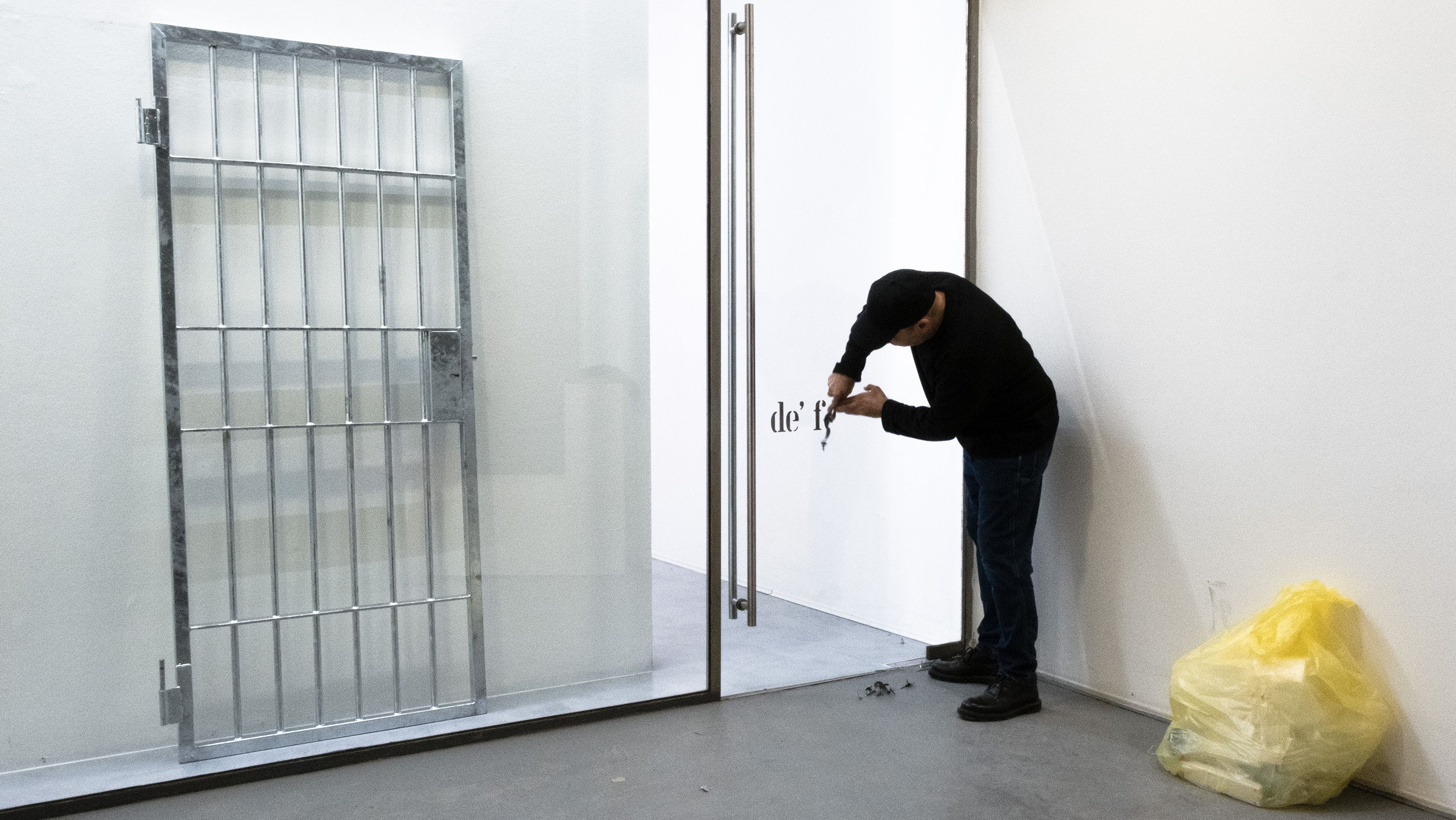
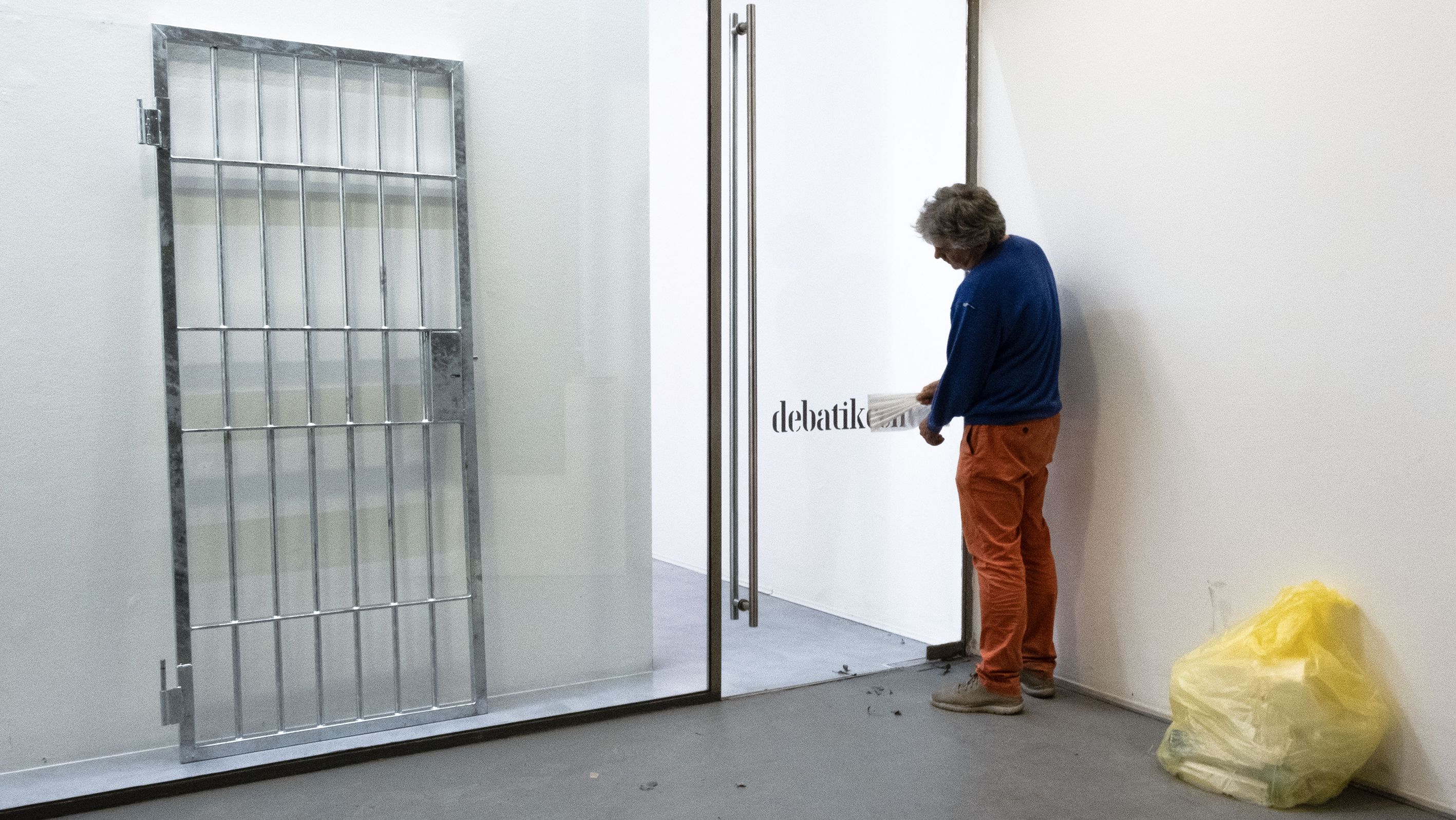
La Société Spectrale, EXCHANGE (de'foscherari / debatikcenter), 2025. Intervention on the glass door of the Galleria de'Foscherari. Courtesy of Galleria de'Foscherari and DebatikCenter of Contemporary Art. © D.C.C.A. Archives.
The exhibition project spans the D.C.C.A.'s twenty-year body of work, describing it as an archive, but also presenting it as if it were a research and training center, both inside and out. During the preparations for the exhibition, together with Fabiola we agreed on the necessity for something to happen overnight, outside the exhibition space. Maybe something has already happened, or maybe it will happen soon.
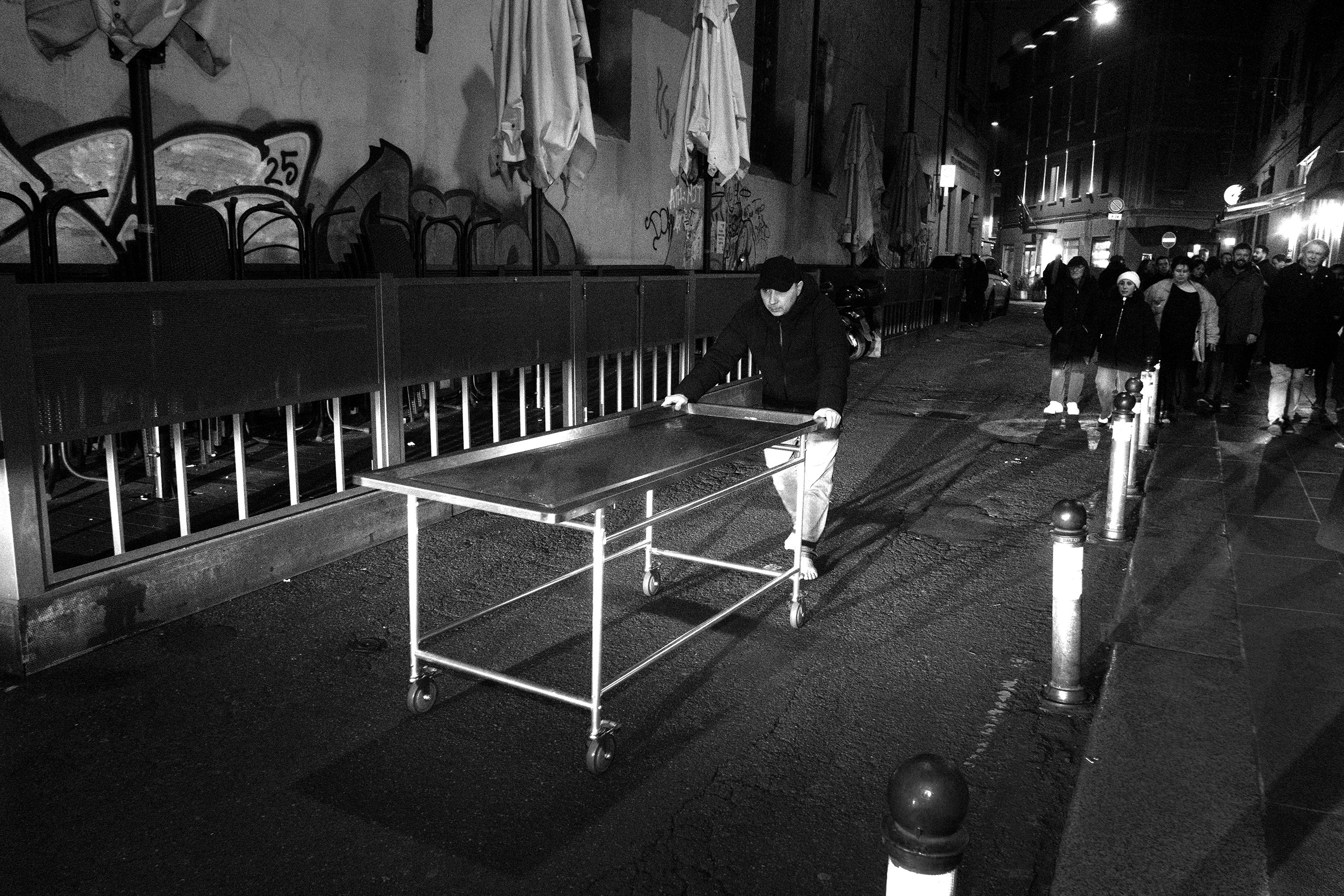
Posthumous action at the exhibition PUSHING THE LIMITS. Bologna, February 7, 2026. First act of Rousing Social Order: TRACKING SHOT, by Armando Lulaj. Courtesy of Galleria de'Foscherari and DebatikCenter of Contemporary Art. © D.C.C.A. Archives.
Furthermore, for PUSHING THE LIMITS, the entire gallery facade was conceived as an action zone, an initial activation space; the street itself became part of it. It is no coincidence that, even before approaching the door, you can listen to Radio Desertion, a sound installation that aims to stimulate people to desertion and other oppositional practices through the voices of poets, artists, critics, theorists, philosophers.
I always say that we have to learn to move like dust on the road.
CM: Your work is often referred to as "militant", a term that is used as much today as it is misunderstood. However, a form of militancy emerges in your projects that coincides neither with propaganda nor with direct activism, but with a continuous redefinition of the relationship between image, document, and action. How do you understand this militancy, and how does your work fit into -- or oppose -- the Albanian and international cultural system?
PXH: The term "militant" is often used as a shortcut, which serves to identify a position and stop questioning the complexity of an artwork or a research project. In this sense, rather than describing a practice, it helps make it easily readable and therefore neutralizable. In our case, militancy has to do with the rejection of neutrality. It does not look like a position declared once and for all, but rather like an ongoing practice. For this reason, it becomes a working method that seeks to keep conflict open, rather than resolve it (only) aesthetically, producing discourses that do not seek consensus, but make visible relationships of power, responsibility, and complicity.
Compared to the Albanian cultural system, this firm approach of ours has often put us in an awkward position, with the result that our names, our works, have been blacklisted by the state cultural apparatus as practices of exclusion. All this occurs in a context where the majority of artistic structures that define themselves as "independent" actually function as tools for legitimizing power, helping to clean up the image of the government and institutions involved in corrupt practices. Even at the international level, the situation is not much different. Criticism is especially accepted when it remains symbolic and easily controlled. Our work, however, seeks to remain in a zone of instability, where the goal is not to accompany change, but to make contradictions visible.
AL: It would be more accurate to say that we collectively operate as cultural agitators. Our performances are not performances in the strict sense of the term, but rather targeted acts and actions with very specific intentions that historically, since the birth of the D.C.C.A., arise from a careful reading of reality and the sites where they are performed. Pleurad initiated the Strikes section of the DebatikCenter with precisely these intentions. The very reorganization of the D.C.C.A. has more to do with these shortages, these strategic reorganizations, these actions, considering them artistic practices that are disappearing or being eliminated from the so-called Albanian art scene.
On the other hand, more substantial work has been carried out in the fields of criticism and theory. Traditionally, there has been a dearth of serious critical texts, both on the history and theory of contemporary art. Everything there was, was based on curatorial texts produced as accompaniments to exhibitions, which theoretical assumptions were more reflections, testimonies, of the trait of nepotism, and personal communications. Because of this, a proper theoretical and academic framework on the topic, which asks questions and is based on in-depth research, was missing. Jonida curated this section and began shaping it with other local and international scholars. Nowadays, research in the field of contemporary art is conducted through dedicated academic channels. Now, these are some of our "marginal" activities that define our militancy.

Pleurad Xhafa, Untitled, 2017. D.C.C.A. Strikes Section. Intervention on Skanderbeg Square where Ardit Gjoklaj's name is clearly visible on the tiles. © D.C.C.A. Archives.
JG: The real militants in the Albanian art scene are those artists and cultural workers who are complicit with the country's political and economic elites. Today, these individuals constitute the majority of the Albanian contemporary art scene, and it is not an exaggeration to say that they are also more united than ever before. The infamous fusion of art and politics in Albania since the beginning of the new millennium has always had precisely this purpose though: the production of a militant cultural apparatus helping to artwash not only corruption, but also fascistic policies like the migrant detention camp in Gjadër.
La Société Spectrale: As mentioned above, these efforts intensified after 2013, and the Center for Openness and Dialogue is certainly an example of this. But the C.O.D. ultimately failed: it never managed to become the real center of contemporary art in Tirana. This was partly due to the limitations faced by the C.O.D. as a public institution. This role was eventually occupied by Harabel Contemporary Art Center, a "non-governmental organization" that was much more successful in its goals -- too successful in fact, since it is now at the center of a huge corruption scandal, as a result of which the mayor of Tirana is currently behind bars, facing a long list of serious accusations. For about six years, however, Harabel dominated Albania's contemporary art scene and was the main liaison between artists and cultural workers, on the one hand, and the country's economic/political elites, on the other hand.
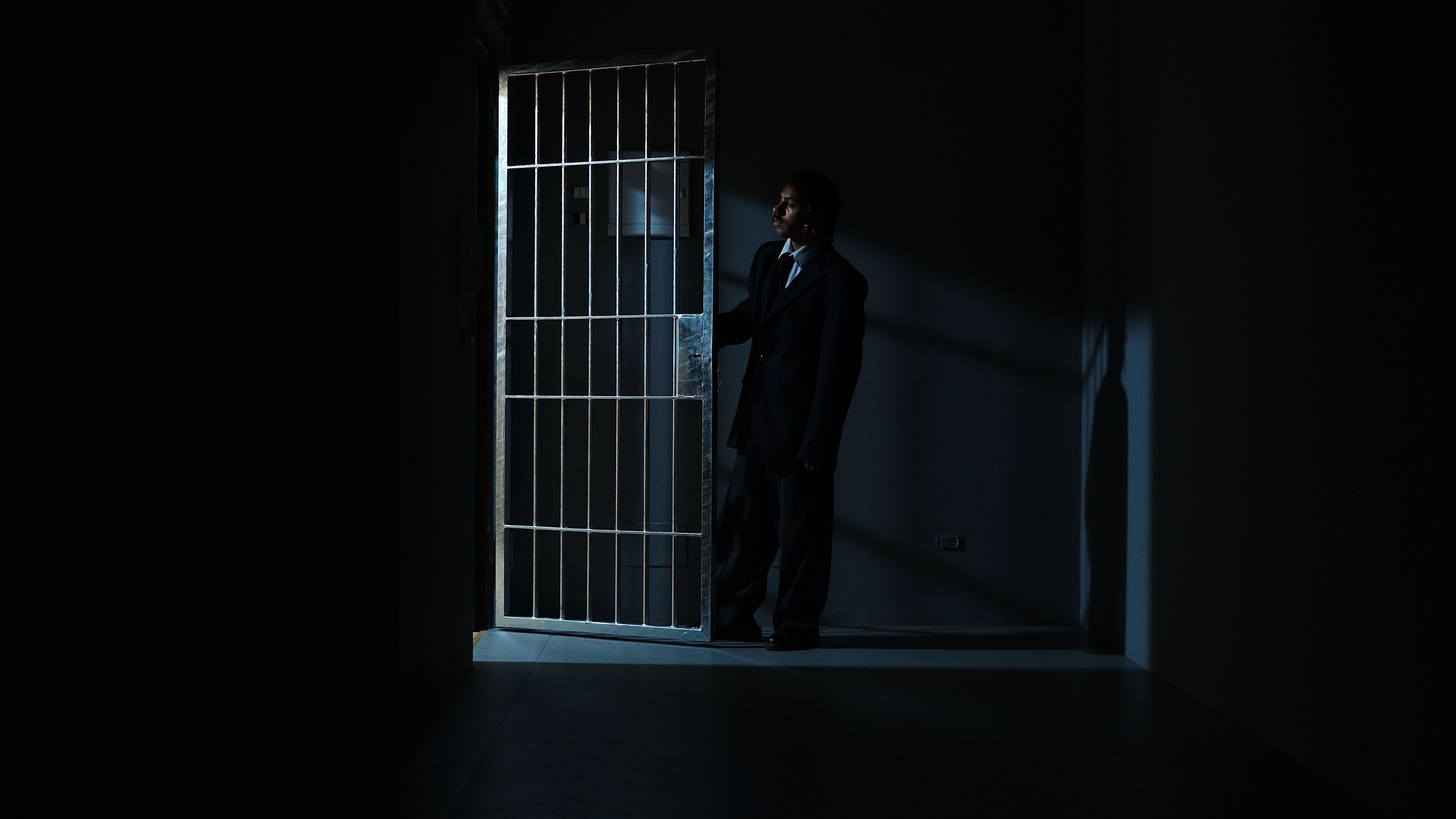
Partial view of the exhibition Two Hours of Fresh Air, 2024, part of MANIFESTO Great Wave, at the ZETA Gallery, transformed into a prison for the occasion. Courtesy of the Debatik Center of Contemporary Art and ZETA Contemporary Art Center. © D.C.C.A. Archives.
Even before Harabel's fall from grace though, a new "creature" had begun to emerge: the Albanian Visual Arts Network (AVAN). This "network", initially sold to the public as a "union" of all art organizations in Albania, which would ostensibly pressure the government to improve working conditions for artists and cultural producers and advocate for them, now effectively operates as an arm of the Ministry of Culture and has become the bridge between the so-called Albanian "independent" art scene and the government. That is to say, it regularly coordinates its activities with the Albanian Ministry of Culture and is regularly financed by the latter. In recent months, the former Executive Director of AVAN has taken over as the Director of the Albanian National Art Gallery, and one of the first steps taken by the newly appointed Director was the announcement of a strategic collaboration between the Albanian National Art Gallery and AVAN. In this way, the triangle composed of the Albanian government, the "official" art scene and the "independent" art scene is neatly closed.
CM: One of the strongest traces of the journey is the role of the archive: not a classificatory archive, but a device that produces ambiguity, that keeps alive the contradictions of the present. How do you build your archive? What criteria do you adopt -- if any -- when choosing what to keep, what to transform, and what to recycle as a subject for debate?
JG: When we decided to reactivate the DebatikCenter of Contemporary Art back in 2017, we also thought about building a website through which the activities of the D.C.C.A. and its associates could become accessible to a wider audience. We also talked about what this website should look like and ultimately settled on the idea of an archive, because we believed that the kind of artworks and also the type of discourse that we wanted to produce went against the prevailing tendency and animating principle of the times. So, we envisioned the D.C.C.A. website like a repository for the accumulation of traces -- documentation of artworks, fragments of discourse -- that were somehow out of place and also out of time. As a heterotopic space, the archive felt like an obvious idiom for the presence of other places and times within the space-time of the present, if only as political fiction and/or sedimented potentiality. In this case, the archive represented (represents) a strategy for carving out space and time where/when the opportunities to do so were (are) becoming increasingly scarce. But this is only one possible use of the archive as a mode of operation in the present; I think that there are other possible uses. Generally speaking, I think that adopting an archival lens towards the present can prove beneficial (politically speaking) in our time, which is of course a time that is profoundly structured by crisis -- or, rather, crises -- foremost amongst them climate change. This is not in spite but rather because of the fact that the catastrophic horizon of the present moment throws the idea of the archive itself into crisis. By which I mean that the arrival of the future upon which archival work is predicated on may, in our case, never occur. On the one hand, this means that we can no longer collect "stuff" safely in the knowledge that the artists or scholars of the future will use it to interpret the past (our present). On the other hand, once the archive is cut off from its futural dimension, it is also freed to become an active mechanism for understanding and reconfiguring the present. Under these conditions, the very act of looking at the present through an archival lens represents a radical gesture, because it implies transforming the present into something that is already past, thereby introducing a radical break within the present, which could create the conditions for its overcoming and the imagining of alternative futures, something we are sorely in need of.
CM: The DebatikCenter is a collective, but also a production center, an observatory, sometimes a film laboratory. What are the internal dynamics that make this plurality possible? How are the design and discussion phases structured, and what role does conflict -- internal, political, aesthetic -- play in your way of working?
JG: I have always thought that the D.C.C.A. is an exercise and an experiment in collectivity: in being/feeling/imagining/thinking/working with others. And by others I do not mean us as founders, but all of our collaborators over the years. So this "plurality" that you mention is a goal in itself, it is not merely a means to an end.
PXH: D.C.C.A. is a bridge, a point of connection rather than a collective in the traditional sense of the term. Different people, practices, and roles meet and work together in ways that vary across projects and contexts. This plurality is based on a fundamental element: trust. Mutual trust, which continually arises and is built on the need to share responsibilities and positions to advance practices and interventions that question mechanisms of power, in contexts where the space for dissent is progressively reduced. Without this basis, this kind of shared work would not be possible.
There is no single, definitive form of organization. It is the projects, from time to time, that define how one works, which roles emerge, and what responsibilities are assumed. For example, the MANIFESTO project, which lasted about five years and consisted of three main events held primarily at the Zeta Contemporary Art Center in Tirana, was born from an initial idea by Armando, and then developed into various sections through a broad collaborative process involving more than thirty people. Typically, projects start from an idea that develops, transforms, and takes shape over time through collective work. In this path, it is normal for different positions and moments of tension to emerge. However, these ideas arise from concrete materials, field research, archives, images, or specific situations, and are discussed throughout the process. Discursive confrontation is not just a preliminary phase, but a central part of the work that accompanies the entire process, from the beginning to the realization and often even beyond.
AL: Over the years, the D.C.C.A. has produced several exhibitions, artist films, a book series, collective and individual works; it has organized local and international conferences, participated in protests and strikes, written the only open letter from the art world against the demolition of the Albanian National Theatre, authored and activated a manifesto, and organized many other side activities that cannot be mentioned here. In this context, in addition to collective work, each of us has produced a corpus of works that is exquisitely individual and recognizable as such. However, there remains a problem inherent in the authorship of the work. Sonja Lau, D.C.C.A. collaborator, critic and curator, writes in this regard: "With the question of authorship now outdated, I wonder: Should the artist himself disappear sooner or later?".
When we work collectively, we often try to "kill" the artist in each of us, to banish him from the scene. Personally, I've always been interested in a work process where I can mix styles, ideas, concepts, perceptions, cultures, practices, which at first glance create an uncontrollable and profound fusion, but which translate into something simple and enigmatic, hidden under many layers to contain the scene, make the scene vibrate -- make the display explode.
We can sometimes be very precise in collective work, while other times not so much, and the work, even if conceived and created by only one of us -- and recognized as such -- takes the name of the collective because it was produced within a specific context. All the work of the MANIFESTO project was produced more or less like this.
I firmly believe that the time has come to take the work of the D.C.C.A. to the next level.
CM: Many of your projects operate in public or semi-public spaces, pushing artistic action into territories where the response is uncontrollable. What kind of relationship do you look for with the public? And what responsibility do you place on those who go through your actions or installations, voluntarily or not?
PXH: I would like to refer to an action we had planned to activate for the opening day of PUSHING THE LIMITS, at Galleria de'Foscherari. The idea was simple: at 6:00 p.m., the exact moment the public entered the gallery, a few buckets of water mixed with chlorine would be poured at the entrance, presenting those present with a direct choice: crossing meant accepting a procedure. In addition to the physical act, chlorine would have saturated the air with a clinical, pungent odor, marking an operating threshold. This is not a metaphor. It is a protocol actually used in the 1990s on the border between Albania and Greece, imposed by the Greek authorities, which forced Albanian citizens, before transit, to walk through chlorine tanks. The same practice, even more violent, continues to exist today in places like Lampedusa, where the bodies of newly arrived migrants are stripped, disinfected with chlorine, and only then placed in the reception system. Here disinfection, which has more to do with hygiene, marks an abuse of power in which the body is deprived of its political status. Transferring the entire procedure to the door of an art gallery means shaking up the role of the spectator. No longer an observer, no longer an interpreter, but a body exposed to an imposed condition.
AL: The strongest reactions in relation to a work of art usually come from those who frequent or are part of the art system. However, they are not the most truthful, in the sense that more often than not these are scripted and institutionalized responses, highly conformist, destined to circulate within the bubble that is the art world.
I must say that I am very interested in that world led by power. I'm obsessed with how power moves. Power is a concept I often explore in my work. In my experience, contemporary art is subjected to interests that represent different levels of power, interests that are driven by multiple forces that go far beyond the work of art.
At present, interest in Albanian art has somewhat diminished. In Albania, those who have the resources, money, and power to create something new now limit themselves to "copying" from abroad. On the other hand, those who come from outside to work here take without giving anything in return. They say it's time to give back! They also preach that the space for acceptance was already created in the 2000s, that the artistic community had already assumed a position of authority and consolidated in those years. That train has left the station. So they say. I think they are wrong!
The task ahead is to once again question the established paradigm and at the same time open up a new horizon. A new discourse! I appeal to young artists that this world is not going to open up any space for you, and your space has not yet been created. It must be created now and must be done persistently! Why are we still willing to listen to these preachers from the past about what should be done now?
With our work we are also addressing that type of spectator who is often completely unaware of the power structures of contemporary art. Personally, I find it interesting to penetrate into the streets, the suburbs, and other territories where the impact on the audience is direct and genuine, violent perhaps, but not influenced by any of the forces I mentioned earlier.
These hypothetical viewers have a more genuine perspective because they have nothing to gain. The only thing that happens in those contexts is an exchange, which is priceless. We noticed this with the Moving Billboard project (2023), in which 24 billboards by 24 artists, from Kioumars Pourahmad to Walid Raad, from Dziga Vertov to Zef Bumçi, were placed on street corners in Tirana, remaining in situ for one hour each. Again, the billboards were designed mostly for unsuspecting and unknown viewers. However, in terms of activation, it was very interesting to place a billboard from the Palestinian collective The Question of Funding, entitled A Question, in front of the Albanian Prime Ministerial Office, where a neon marquee from Philippe Parreno illuminates the entrance.
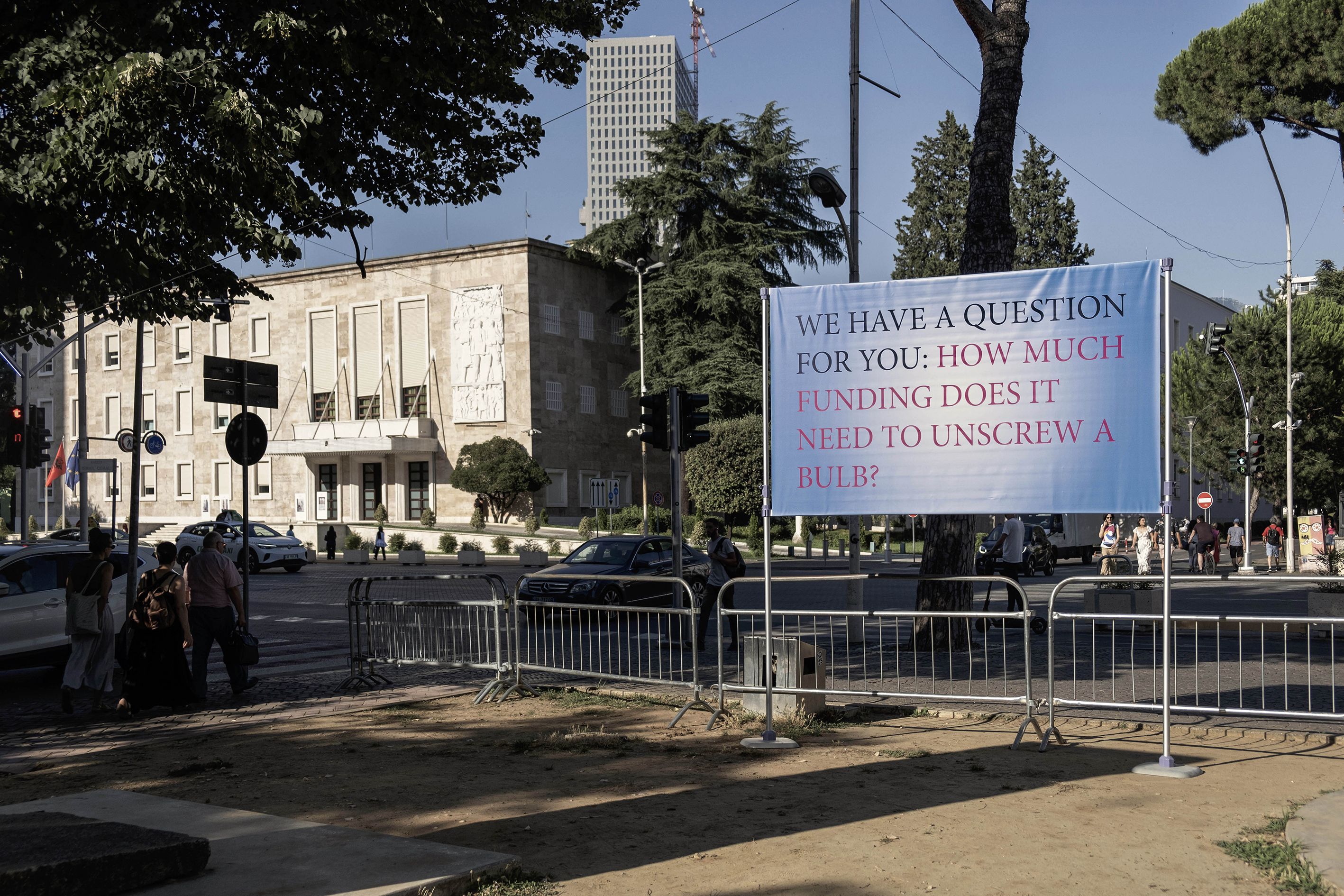
The Question of Funding, A Question, 2023. Billboard. Project for MANIFESTO Desertion: Moving Billboard 2, 2023. Courtesy of The Question of Funding and DebatikCenter of Contemporary Art. © D.C.C.A. Archives.
Or place a beautiful work by Christoph Schlingensief, depicting unemployed people trying to raise the water level of the lake in order to flood Chancellor Helmut Kohl's house, near Albanian Prime Minister Edi Rama's multimillion dollar property in Surrel. It was surreal to place these images in highly charged locations and have the opportunity to stir up ideas with people who approached the billboards randomly, which sparked a deeper conversation than contemporary art is now accustomed to. We believe in this kind of spectator. We believe in the spectator to come.
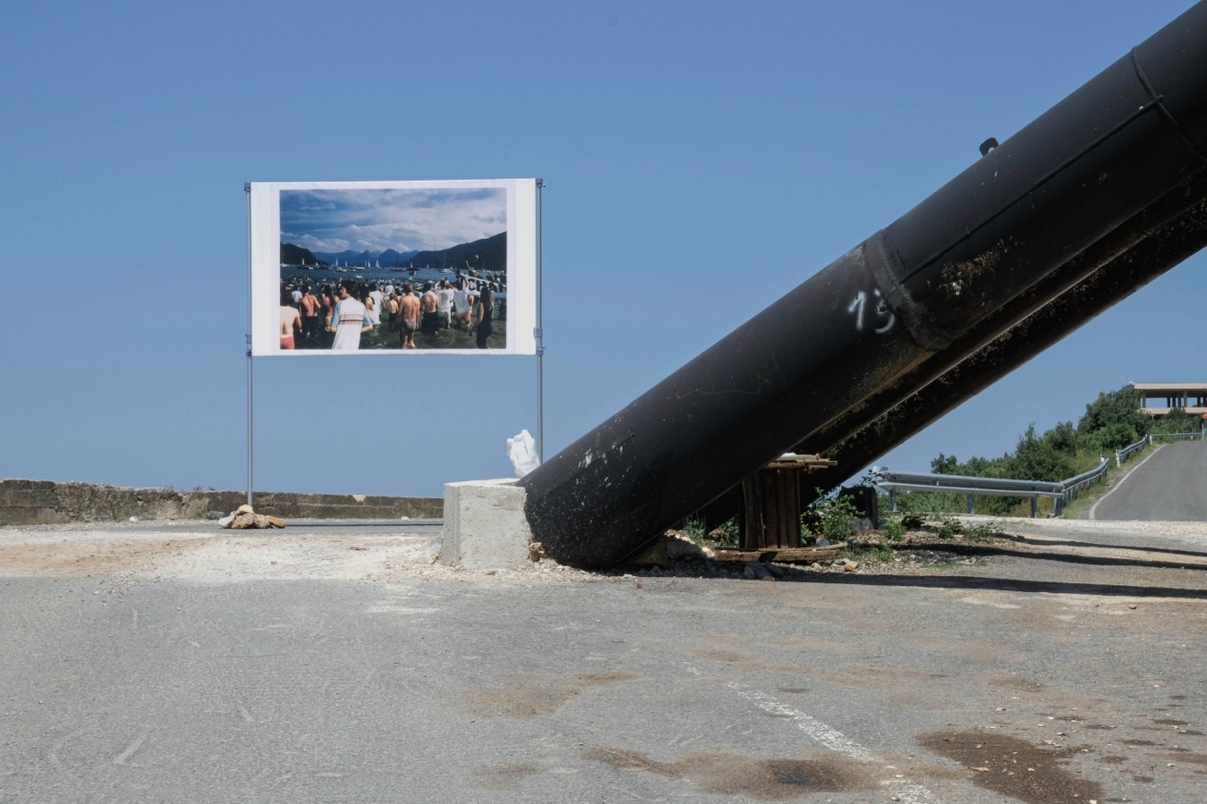
Christoph Schlingensief, Chance 2000, documentation of Aktion Baden am Wolfgangsee (Swim in the Wolfgangsee), 1998. Billboard. Project for MANIFESTO Desertion: Moving Billboard 2, 2023. Courtesy of Bettina Blümner, Aino Laberenz/Nachlass Schlingensief and DebatikCenter of Contemporary Art. © D.C.C.A. Archives.
In conclusion I really think that art is a very long game, a whirlwind. You can play or let it go, but the decision must be made as soon as possible.
Bologna–Tirana, December 2025–January 2026
Claudio Musso is an art critic, independent curator, Professor of Phenomenology of Contemporary Arts at the Politecnico delle Arti di Bergamo-G. Carrara Academy of Fine Arts. He writes for Artribune, Arteecritica, Il Giornale dell'Arte, and collaborates with NEU Radio.
NEXT LEVEL
(click here for the italian version)